Guide · Cost
What a paver patio costs around Sequim and Port Angeles
The honest answer is "it depends." Here's what it depends on, so the number in your proposal makes sense.
Why online prices don't help much
Search for patio prices and you'll find national averages per square foot. They're not much use here. They're built from a mix of regions, soils and labor markets, and they rarely say what's included: how deep the base goes, whether there's a wall or step involved, or whether the number covers hauling away what gets dug out. Two quotes for "the same patio" can be far apart simply because one includes things the other leaves out.
Two patios of the same size can be priced very differently once the ground, the slope and the access are in the picture, so we don't publish a range. Here are the seven things that actually move the price of a patio on this part of the Peninsula.
1. Size and shape
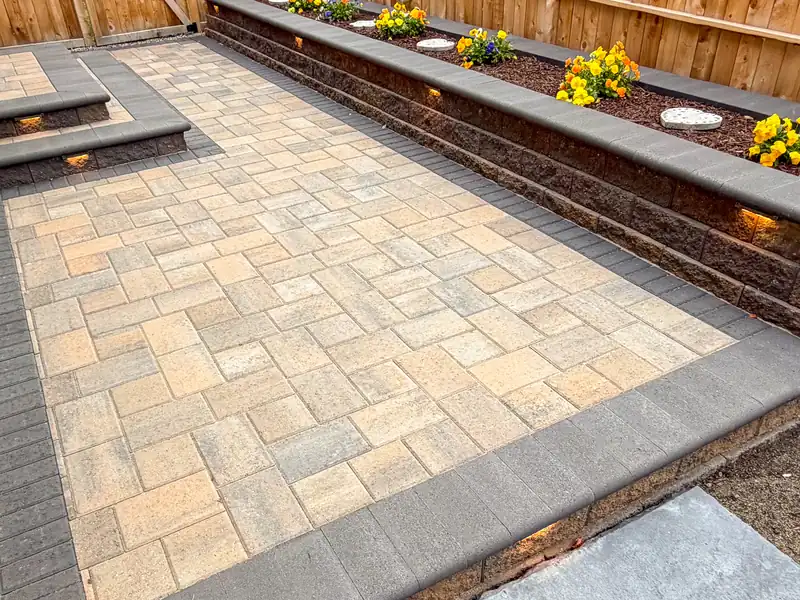
Square footage is the starting point, but shape matters almost as much. A simple rectangle goes fast. Curves, tight radiuses and lots of corners mean more cuts, more waste and more time. A curved patio can be worth it, but it costs more per square foot than a square one.
2. What's under it
This is the part people don't see and the one that varies most. The base has to be dug out, rock brought in, and compacted in layers. On sandy, fast-draining ground the base can be fairly standard. On wet clay or glacial till, it often needs to be deeper, and sometimes drainage has to go in under or beside it. We look at the ground at the visit, and the final base is sized for what turns up once the dig starts.
3. Slope
A flat yard is the cheapest place for a patio. Once the ground slopes, the patio either needs to be built up on one side, cut into the hill on the other, or held up with a wall. A retaining wall or seat wall along one edge can double as seating, but it's a separate line in the budget.
4. Access
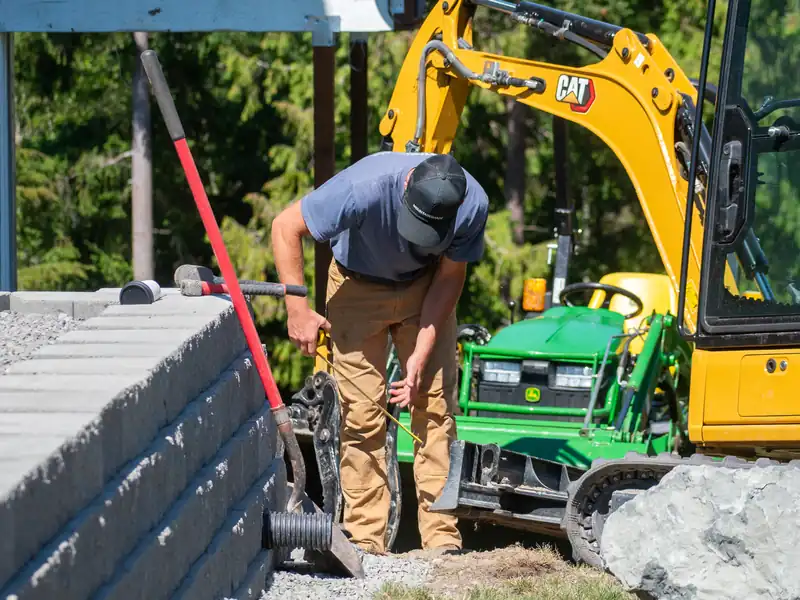
Can a small machine get into the backyard, or does everything go through a narrow side gate in wheelbarrows? Tight access adds hours, and on some jobs that's the biggest single factor after size.
5. The pavers you pick
Paver prices vary by style, thickness and finish. Large-format pavers and premium textures cost more than standard shapes, and complex patterns take longer to lay. A border in a contrasting color adds a little time and a lot of finish. We show you the actual pavers at the visit, so you can compare a few in person.
6. Add-ons
- Steps from the house or deck
- A fire pit, gas or wood-burning
- Seat walls or raised planters
- Lighting, wired before the pavers go down
Each one adds to the total, and each is cheaper to build at the same time as the patio than to add later.
7. Removal and cleanup
If there's an old slab, a deck, a lawn or a rock bed where the patio is going, it has to come out and be hauled away. That cost is real, and a good proposal lists it.
Getting an accurate number
The fastest way to a real number is a visit. We measure, check the ground and the access, talk through add-ons, and a basic patio can usually be priced right there at the visit. Your written proposal spells out the size, the base, the pavers and everything included, so you can compare it fairly against anyone else's.
Patio cost questions
Is a bigger patio cheaper per square foot?
Often a little, because the setup and finishing work is spread over more area. The base and pavers still scale with size.
Can you give me a ballpark over the phone?
Not a useful one. Size, ground, slope and access all move the number, and we can't judge those without seeing the yard. The visit is free, and that's where we can usually put a price on a basic patio.